Monday, December 5, 2011
Ushuaia (by Jordy)
Sunday, December 4, 2011
Friday, December 2, 2011
Teatro Colon presents "La Viuda Alegre"
Jordy's Report
Today we went to an opera. It was long and loud. It was mostly in German, sometimes French, Spanish, and English were also mixed in. It was called "The Jolly Widow" it was based off an old comedy. It was about love, a fan, just like a soap opera. Loud singing and a loud orchestra kept me awake thought I was terribly tired. The floor was marble and I lay down on the cold slab while hiding under my seat. Still sleep would not come. My dad dozed which was very annoying. When I got home though I dropped. The building is called Teatro Colon. Apparently is is very famous. Last time we were here they were renovating it. The building is beautiful. Walls are a dull gold. Stained glass is perfected with the tiniest detail. Balconies hang around the stage in a protective semi-circle. For me the opera wasn't the show, the building did it for me.
Xander's Report
Last night we went to a three hour long opera at the Teatro Colon. The Teatro Colon is a European style opera house located in Buenos Aires, Argentina. It originally opened in 1857 but underwent a major renovation from October 2006 to May 2010. There are seven floors vertically stacked in a u-shape with the stage in front. The ceiling is a dome with a light fixture in the middle. Surrounding it are beautifully painted angels. As an outer ring around the dome, there are names of some of the world's most famous composers. Amount them were Beethoven and Joseph Haydn. It was very formal and I kept expecting Austin Powers or James Bond to show up and get in a gun fight with some bad guys.
We watched "La Viuda Alegre". It was your basic love story, but with a twist. It was the woman that had all the money, and that because she was a widow and inherited all of her dead husband's money. It was also different because it was three times as long. It was very hard to pay attention because it was in not one but two foreign languages. The talking and singing was in German and then there was a translation on a screen in Spanish, so to tell the truth I would watch for about 5 minutes every ten minutes. After each act we would go down a floor and get something to drink. My dad slept a lot and my brother tried to sleep.
Andrew's Report
ZZZZZZZZZZZ
Thursday, December 1, 2011
Xul Solar-an Argentine Artist and Intellectual 1887-1963


Alejandro Xul Solar (short for Oscar Agustin Alejandro Schulz Solari) is an Argentine artist from Buenos Aires. In the exhibit of South American artists that we visited in the MALBA, he had a small room with about ten pieces inside. We sat on a bench and sketched some of his work. His use of geometric shapes and earthy colors actually separate him from the artists in the gallery. He uses numbers and letters. His images make it seem like you are in a dream due to faded brown blotches in the background. His art looks strangely Egyptian and is similar in style to Klee, Kandinsky, and Chagall. His preferred medium was water color. Xul Solar was an intellectual who created two languages in addition to his work as an artist. He kept company with the famous Argentine writer Jorge Luis Borges.
To give you an idea of Xul Solar's mind, here is a quote:
"I am a world champion of a game that nobody yet knows called panchess (Panajedrez). I am master of a script that nobody yet reads. I am creator of a technique, of a musical grafĂa that allows the piano to be studied in a third of the usual time that it takes today. I am director of a theatre that as yet has not begun working. I am creator of a universal language called panlingua based on numbers and astrology that will help people know each other better. I am creator of twelve painting techniques, some of them surrealist, and others that transpose a sensory, emotional world on to canvas, and that will produce in those that listen a Chopin suite, a Wagnerian prelude, or a stanza sung by Beniamino Gigli. I am the creator, and this is what most interests me at the moment, apart from the exhibition of painting that I am preparing, of a language that is desperately needed by Latin America.”
-From Xul Solar’s own writings
After we sketched in the museum we went home and created our own version of a Xul Solar piece in oil pastels.
Wednesday, November 30, 2011
MALBA-Carlos Cruz Diez "El Color en El Espacio y en El Tiempo (by Xander)
One of the exhibits we visited was titled "El Color en El Espacio y en El Tiempo which translates to "Color in Space and Time". The artist was Carlos Cruz-Diez. He does Kinetic Art which is a movement that occurred in Paris, France in the mid 1950's. He uses bright colors and parallel lines to create pieces that leave your head spinning.
Like many modern artists, he started with painting more typical, classic paintings such as bowls of fruit or other realistic scenes. His exhibit showed hi progression from classic paintings, to his kinetic art and finally to a w-shaped room with each division bathed in a different color: blue, pink and green. The colors were extremely vibrant and your eyes would hurt. In between each section there was a four foot tall rectangular pillar, one half bathed in one color and the other half bathed in the other adjacent color. As a whole, it was a brilliant, radiating neon gradient.
Kinetic means moving, and that is exactly what Carlos's pieces do. They are kind of like a hologram. If you start on one side of the work and move to the other side in a semi-circle it will completely change its appearance until you are back to the opposite side. It's colors as well as shapes will morph and change until it looks like it did at the beginning of your semi-circle. For these pieces, the materials he uses include a wood base, painted parallel vertical lines of bright colors and to top it off parallel strips of plexi glass on their thin edge. I only have examples of works that use light. We were not allowed to take photos of the wood pieces.
Tuesday, November 29, 2011
Pampas and Gauchos (By Xander)
Another "species" that lives on the pampas are the gauchos. Gauchos are the original cowboys of the Argentine pampas. One thing that categorized them apart from other cowboys was their saddles. First of all, they didn't use a horn or pommel (the thing at the front of the saddle that you can hold onto with your free hand while you ride). Also, instead of using one big leather saddle, they used multiple layers of blankets with a sheep skin on top held together by straps. We (Americans) commonly call their style of riding "Indian Style".
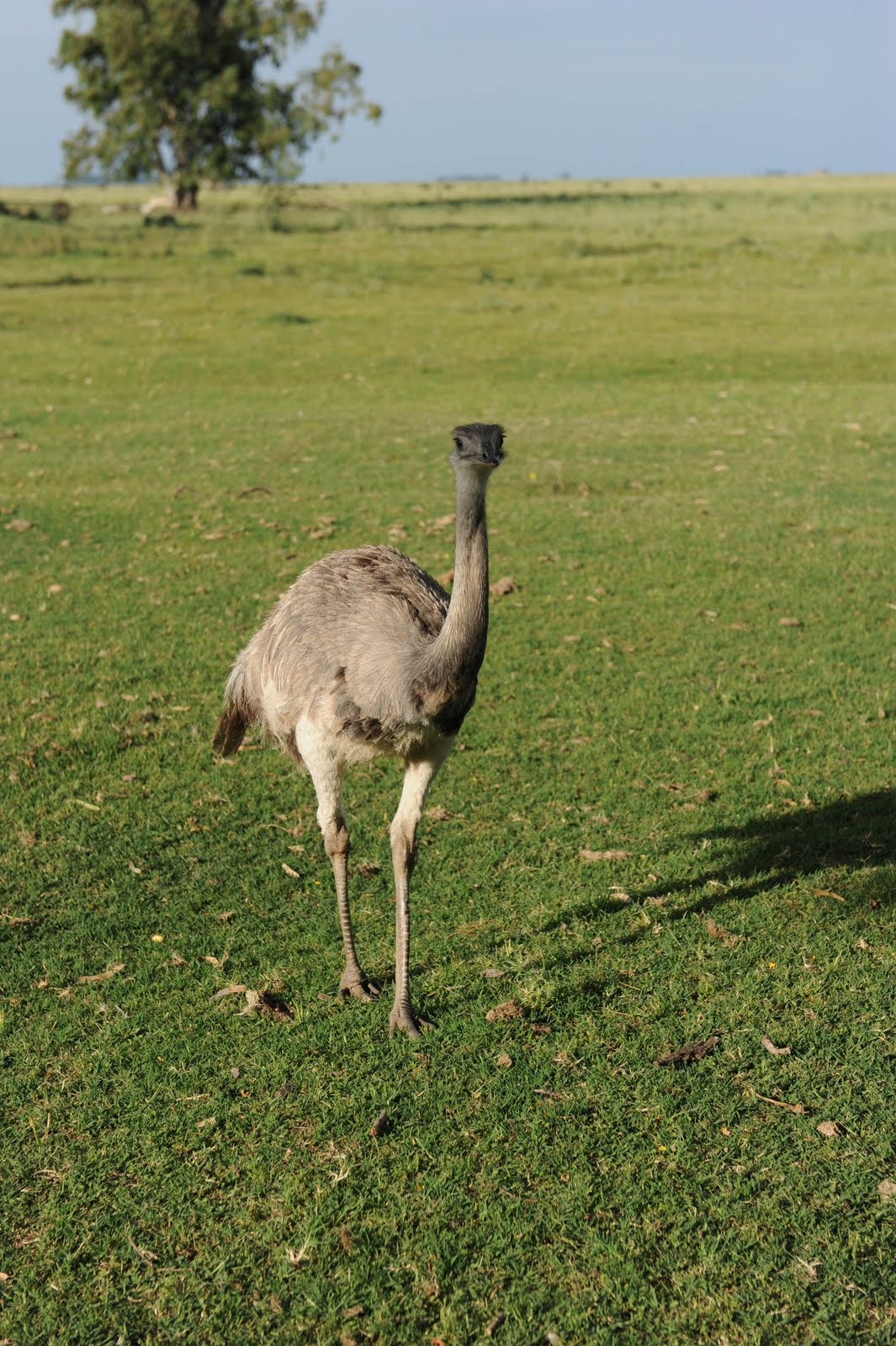
They were also equipped with a few typical clothing and tools as well as some items that are unique to guachos. For a hat, they use a beret. They also wear a cravat (scarf) with a symbol attached. A long sleeve dress shirt, pancho for cold weather, jeans, boots with boot covers and alpargatas (special slippers) were other articles of clothing that gauchos use. Alpargatas were traditionally made with a rope sole and canvas body, but the type that is modernly used has a gum sole and canvas body. Some tools they use include a facon (long knife), a whip, and a boleadora. A boleadora is a strip of leather that forks at the end with two heavy rocks on either side of the split, and one lighter rock on the end of the non forked side. This would be swung around and then released towards their target of a nandu or cow/bull. It would then tangle the animal's legs and they could do what they desired to it (most likely eat it).
A traditional Gaucho meal is an asado (barbecue). There are two fire pits dug into the ground. One of them holds the wood that turns into coals to cook the meat. They use a very hard wood that is native to Argentina that burns very hot and long. Once the coals reach a certain size, they are shoveled into the second fire pit. The second pit has a parrilla (grill) approximately ten inches above the hole. You slowly cook the meat for about one hour before eating it.