Showing posts with label xander. Show all posts

Friday, December 9, 2011

The Yanama/Yaghan People of Tierra del Fuego

Yaghan Family

Authors Note: Because Yanama means "man" in their native language, those who are still around prefer to be called the Yaghans.

The Yanama were an indigenous Native American tribe in Tierra del Fuego, Argentina. Their story is very similar to the other indigenous people of the Americas. Their lives would be going on as usual, and then all of a sudden, bam, explorers from Europe would come and annihilate them. Some would die from hunger, others from disease, and others from violence. When the explorers came, they also introduced the Yanama to clothes. They weren't used to that form of maintaining their warmth, so many died from that as well. Today, there is only one true blood Yanama. Her name is Christina Calderon. She is very old, and within a matter of years, an entire race will be extinct.

Christina Calderon-the last Yaghan

Being in such a cold, dry place, the Yanama people did not have a lot of variety in the food they ate. Their main source of food was the ocean. They had a seafood diet that included mussels, penguins, sea lions, seals. One of their major contributors from land was guanaco -- an animal very similar to llama. Unfortunately, when settlers from Europe came, they needed food too. Their most obvious choice was the ocean, so European fisherman raided the ocean and practically eliminated the Yanama's most major food source. Desperate people do desperate things, and the Yanama resorted to eating a bright orange fungus off of the trees that host it. The bulbous fungus is now called Pan de Indio or Indian Bread.

Pan de Indio (Indian Bread)

Their shelter was very simple, yet very effective and was related directly with their food. First, they would dig a hole in the ground that was approximately 2 feet deep and had a 6 foot radius. They would then take branches and form a roof over the hole in another dome. This would provide shelter from the weather and wouldn't topple from the extreme winds. They ate mussels inside their tent and then would throw the shells outside forming a huge purple ring around the tent.

Yaghan Shelter

They were nomads however, and they wouldn't stay in their huts for long. They were hunter-gatherers and they would hunt to get most of their food. Women had an equal place in Yanama society as men. Their form of seal hunting is one way that demonstrates the balance and equality of the couple. I say couple because you were not permitted to have your own canoe until you were married. Then you would make your own canoe and go seal hunting with your partner. While hunting seals, the woman would steer and propel the canoe towards the seal very quickly and silently. While the woman is controlling the boat with her paddle, the man starts to aim his spear. When the spear head hits the seal, it detaches from the shaft, held together by a string. The team then has full control of the seal, so they will wait for it to calm down a little bit before dragging it into the boat.


Hunters

The one key piece of information I haven't yet covered is their clothing. In fact, there isn't much to cover (apparently that was their philosophy too) as they went nude or just with a loincloth. It seems like a bad design because they are in one of the coldest places on earth, but there is more to it. They would wear thick moccasins made of guanaco fur and stuffed with grass to keep their feet warm and protected. They would also rub seal blubber on themselves as well as have plenty of their own fat on them.

Wednesday, December 7, 2011

Estancia Harberton (by Xander)

We spent the night at Estancia Harberton which is a 1.5 hour drive up route 3 from Ushuaia.  The ranch has two guests rooms for overnight visitors.  We were the only guests for the night and the staff was very kind and helpful.  We didn't expect our stay to be an educational experience, but it was!  Gaston taught us about the flora and fauna  both native and invasive.  We had a lovely and unexpected visit from Natalie Goodall the owner who shared her story and the history of the ranch.  Xander writes about it below.
Estancia Harberton was established as a working sheep ranch.  They now operate as an educational tourist destination.  It is located in Tierra Del Fuego, Patagonia, Argentina near Ushuaia.  In it's day, wool from sheep was their major product along with cattle and horses.

In their winter (our summer) of 1995 most of their animals died.  By that time they had also realized that their sheep weren't producers of the highest quality wool, as they lived on rugged terrain and there would often be burrs and sticks stuck in their wool. It was a legendary snow year for South America as it snowed approximately 3 meters (about 9 feet).  Witnesses said that they saw cows completely buried with just their heads above the snow.  The following spring they found many sheep and guanacos dead, hanging ten feet in the air in trees.  Harberton ranch then started the transformation from an active ranch to a historical site.

Thomas Bridges established Harberton in 1886.  He founded the Anglican Mission in Ushuaia to try to convert the Yaghans.  However, he changed his perspective and tried to live in harmony with the native people.  His father and others practically destroyed the Yaghan race and then Thomas came along to try and preserve it.  He even made a dictionary of their entire language.

While we were having dinner at the Estancia, Natalie Goodall, the wife of Thomas D. Goodall who is a direct descendant of Thomas Bridges and runs the ranch, sat down and talked with us.  She was born and raised in Ohio.  She was in her id 20s when she first went to Ushuaia.  There wasn't anywhere for her to stay in the actual city, and someone suggested that she stay at Harberton.  She eventually did after some resistance.  When she finally went to the ranch she and Thomas Goodall fell in love.  Ushuaia and Harberton have ever since been her home.  She was a botanist, but it turned out she had a knack for finding skeletons of marine animals, so she now has a museum of her findings located on the property.  The museum is a major place of research in the field of Marine Biology today.  Her collection is available for study to anyone who desires.

The entire operation of Estancia Harberton is run by interns that want to learn more about marine biology or tourism.  Natalie is a major name in south American Biology.  Natalie's personal story was the most fascinating part of our dinner conversation that night.  I feel lucky to have met living history.

 Jordy collected treasures during our walk and chose to leave them were they belong rather than take them home.


 Jordy and Gaston our naturalist.

 Cleaning bones to be stored in the museum collection

Xander classifying a bone he found in the tundra.

Tierra Del Fuego (by Xander)


Tierra Del Fuego is the Southernmost point on Earth before Antarctica. It is basically a huge island located below Chile and Argentina. It is shared between the two countries, but Chile has the Southern half of the island, and therefore the Southernmost owned territory in the world. We stayed in Ushuaia, the southernmost city of Argentina. Mountains climb straight out of the frigid sea, and like all Patagonian mountains, make you feel absolutely microscopic.


Due to Tierra Del Fuego's southern location, it is freezing. There is about 17 hours of daylight in Ushuaia during the summer (the sun sets around 11:00 at night and rises at about 2:00 in the morning), and during the winter there are very few hours of daylight. After the claustrophobically hot and humid days in Buenos Aires, the cold mountain air was a relief to my lungs and my soul.


Being on the opposite side of the globe as us, they have quite different flora and fauna than in Truckee. It is not very often you see a pine tree, and instead of being annihilated and hated, Scotch Broom is admired and grown in gardens. Penguins, guanaco, and cormorants are three types of animals that you will not find in Truckee, but you will in Tierra Del Fuego.

Friday, December 2, 2011

Teatro Colon presents "La Viuda Alegre"

We went to our first opera at the Teatro Colon.  On our last trip to Buenos Aires it was not open due to renovation so I was excited we had the opportunity to see it this time.  We saw La Viuda Alegre (The Merry Widow) a three hour love story by Franz Laher.  The music was in German so they kindly offered a translation into Castellano on a screen above the stage.  Thankfully we had done a quick bit of research on Wikipidia to get the story line.  It was a great experience listening to German, reading Spanish, and trying to translate to English in my head.

Jordy's Report
Today we went to an opera.  It was long and loud. It was mostly in German, sometimes French, Spanish, and English were also mixed in.  It was called "The Jolly Widow"  it was based off an old comedy.  It was about love, a fan, just like a soap opera.  Loud singing and a loud orchestra kept me awake thought I was terribly tired.  The floor was marble and I lay down on the cold slab while hiding under my seat.  Still sleep would not come.  My dad dozed which was very annoying.  When I got home though I dropped.  The building is called Teatro Colon.  Apparently is is very famous.  Last time we were here they were renovating it.  The building is beautiful.  Walls are a dull gold.  Stained glass is perfected with the tiniest detail.  Balconies hang around the stage in a protective semi-circle.  For me the opera wasn't the show, the building did it for me.

Xander's Report
Last night we went to a three hour long opera at the Teatro Colon.  The Teatro Colon is a European style opera house located in Buenos Aires, Argentina.  It originally opened in 1857 but underwent a major renovation from October 2006 to May 2010.  There are seven floors vertically stacked in a u-shape with the stage in front.  The ceiling is a dome with a light fixture in the middle.  Surrounding it are beautifully painted angels.  As an outer ring around the dome, there are names of some of the world's most famous composers.  Amount them were Beethoven and Joseph Haydn.  It was very formal and I kept expecting Austin Powers or James Bond to show up and get in a gun fight with some bad guys.
We watched "La Viuda Alegre".  It was your basic love story, but with a twist.  It was the woman that had all the money, and that because she was a widow and inherited all of her dead husband's money.  It was also different because it was three times as long.  It was very hard to pay attention because it was in not one but two foreign languages.  The talking and singing was in German and then there was a translation on a screen in Spanish, so to tell the truth I would watch for about 5 minutes every ten minutes.  After each act we would go down a floor and get something to drink.  My dad slept a lot and my brother tried to sleep.
Andrew's Report
ZZZZZZZZZZZ

Thursday, December 1, 2011

Xul Solar-an Argentine Artist and Intellectual 1887-1963


Alejandro Xul Solar (short for Oscar Agustin Alejandro Schulz Solari) is an Argentine artist from Buenos Aires. In the exhibit of South American artists that we visited in the MALBA, he had a small room with about ten pieces inside. We sat on a bench and sketched some of his work. His use of geometric shapes and earthy colors actually separate him from the artists in the gallery. He uses numbers and letters. His images make it seem like you are in a dream due to faded brown blotches in the background. His art looks strangely Egyptian and is similar in style to Klee, Kandinsky, and Chagall. His preferred medium was water color. Xul Solar was an intellectual who created two languages in addition to his work as an artist. He kept company with the famous Argentine writer Jorge Luis Borges.

To give you an idea of Xul Solar's mind, here is a quote:

"I am a world champion of a game that nobody yet knows called panchess (Panajedrez). I am master of a script that nobody yet reads. I am creator of a technique, of a musical grafĂ­a that allows the piano to be studied in a third of the usual time that it takes today. I am director of a theatre that as yet has not begun working. I am creator of a universal language called panlingua based on numbers and astrology that will help people know each other better. I am creator of twelve painting techniques, some of them surrealist, and others that transpose a sensory, emotional world on to canvas, and that will produce in those that listen a Chopin suite, a Wagnerian prelude, or a stanza sung by Beniamino Gigli. I am the creator, and this is what most interests me at the moment, apart from the exhibition of painting that I am preparing, of a language that is desperately needed by Latin America.”

-From Xul Solar’s own writings


After we sketched in the museum we went home and created our own version of a Xul Solar piece in oil pastels.

-by Xander

Wednesday, November 30, 2011

MALBA-Carlos Cruz Diez "El Color en El Espacio y en El Tiempo (by Xander)

Today my mom, my brother and I went to the MALBA, an art museum in Buenos Aires.  Even the benches inside are art.

One of the exhibits we visited was titled "El Color en El Espacio y en El Tiempo which translates to "Color in Space and Time".  The artist was Carlos Cruz-Diez.  He does Kinetic Art which is a movement that occurred in Paris, France in the mid 1950's.  He uses bright colors and parallel lines to create pieces that leave your head spinning.


Like many modern artists, he started with painting more typical, classic paintings such as bowls of fruit or other realistic scenes.  His exhibit showed hi progression from classic paintings, to his kinetic art and finally to a w-shaped room with each division bathed in a different color:  blue, pink and green.  The colors were extremely vibrant and your eyes would hurt.  In between each section there was a four foot tall rectangular pillar, one half bathed in one color and the other half bathed in the other adjacent color.  As a whole, it was a brilliant, radiating neon gradient.
Kinetic means moving, and that is exactly what Carlos's pieces do.  They are kind of like a hologram.  If you start on one side of the work and move to the other side in a semi-circle it will completely change its appearance until you are back to the opposite side.  It's colors as well as shapes will morph and change until it looks like it did at the beginning of your semi-circle.  For these pieces, the materials he uses include a wood base, painted parallel vertical lines of bright colors and to top it off parallel strips of plexi glass on their thin edge.  I only have examples of works that use light.  We were not allowed to take photos of the wood pieces.


Tuesday, November 29, 2011

Pampas and Gauchos (By Xander)

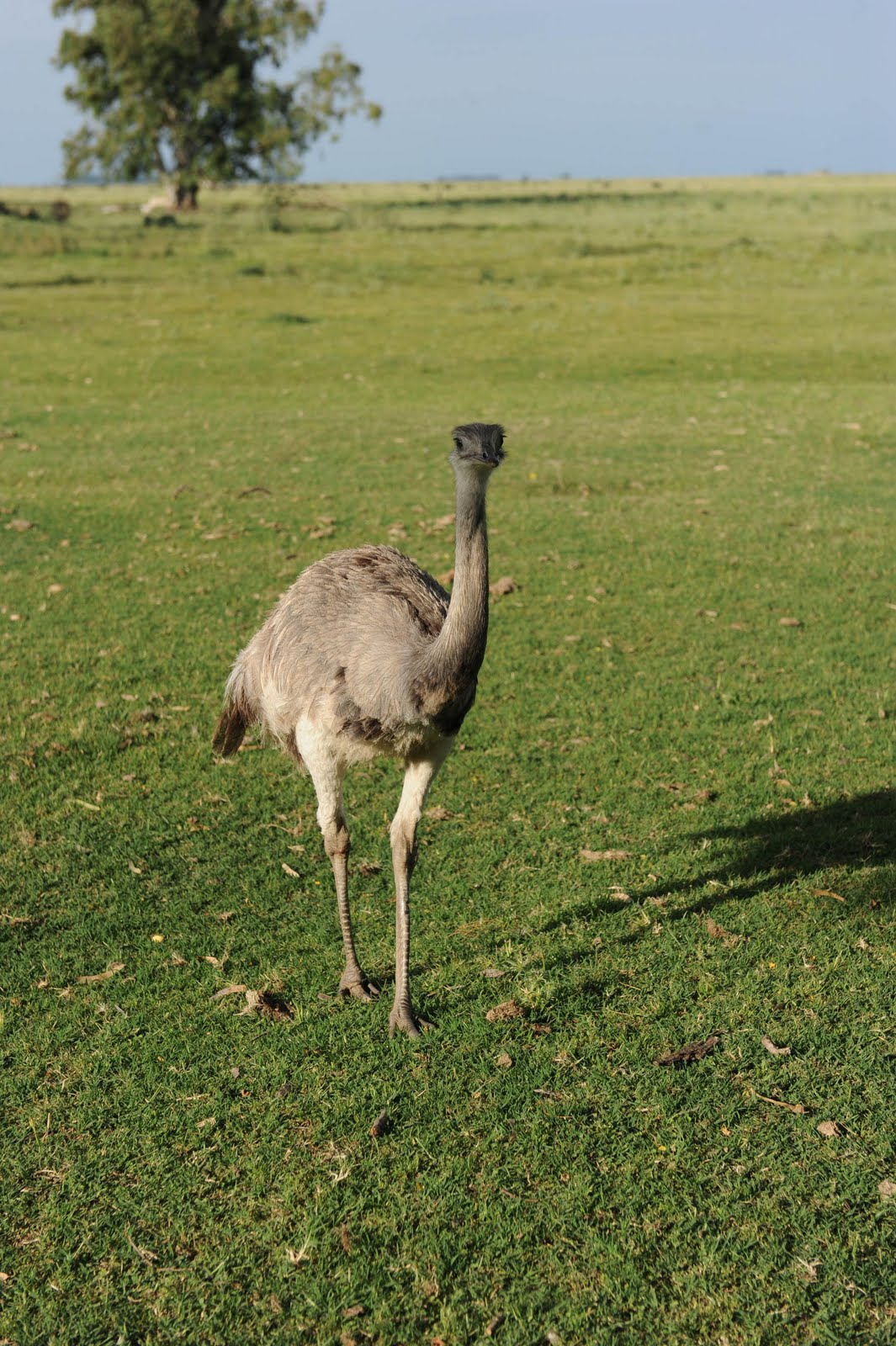
The Pampas are huge flat grasslands that occupy parts of the Argentine provinces of Buenos Aires, La Pampa, Santa Fe, Entre Rios, and Cordoba. The Pampas also occupy much of Uruguay and the Southernmost Brazilian state of Rio Grande do Sul. The animals of the Pampas (that we saw) include jack rabbits, nandu (pronounced nyandoo), cattle, horses, armadillos, owls, and birds like hawks, special Argentine Vultures, and a small bird with a very long tail.


Nandu

Vaca

Another "species" that lives on the pampas are the gauchos. Gauchos are the original cowboys of the Argentine pampas. One thing that categorized them apart from other cowboys was their saddles. First of all, they didn't use a horn or pommel (the thing at the front of the saddle that you can hold onto with your free hand while you ride). Also, instead of using one big leather saddle, they used multiple layers of blankets with a sheep skin on top held together by straps. We (Americans) commonly call their style of riding "Indian Style".

Gaucho Saddles

Guacho y Caballo

They were also equipped with a few typical clothing and tools as well as some items that are unique to guachos. For a hat, they use a beret. They also wear a cravat (scarf) with a symbol attached. A long sleeve dress shirt, pancho for cold weather, jeans, boots with boot covers and alpargatas (special slippers) were other articles of clothing that gauchos use. Alpargatas were traditionally made with a rope sole and canvas body, but the type that is modernly used has a gum sole and canvas body. Some tools they use include a facon (long knife), a whip, and a boleadora. A boleadora is a strip of leather that forks at the end with two heavy rocks on either side of the split, and one lighter rock on the end of the non forked side. This would be swung around and then released towards their target of a nandu or cow/bull. It would then tangle the animal's legs and they could do what they desired to it (most likely eat it).

Boleadora

A traditional Gaucho meal is an asado (barbecue). There are two fire pits dug into the ground. One of them holds the wood that turns into coals to cook the meat. They use a very hard wood that is native to Argentina that burns very hot and long. Once the coals reach a certain size, they are shoveled into the second fire pit. The second pit has a parrilla (grill) approximately ten inches above the hole. You slowly cook the meat for about one hour before eating it.


Parilla